Mini golf scoring and common house rules
Mini golf has one fixed rule: count every stroke, and the lowest total wins. Almost everything else is set by the course or agreed by the group, so the options below are the common ones, not the only ones.
Strokes per hole
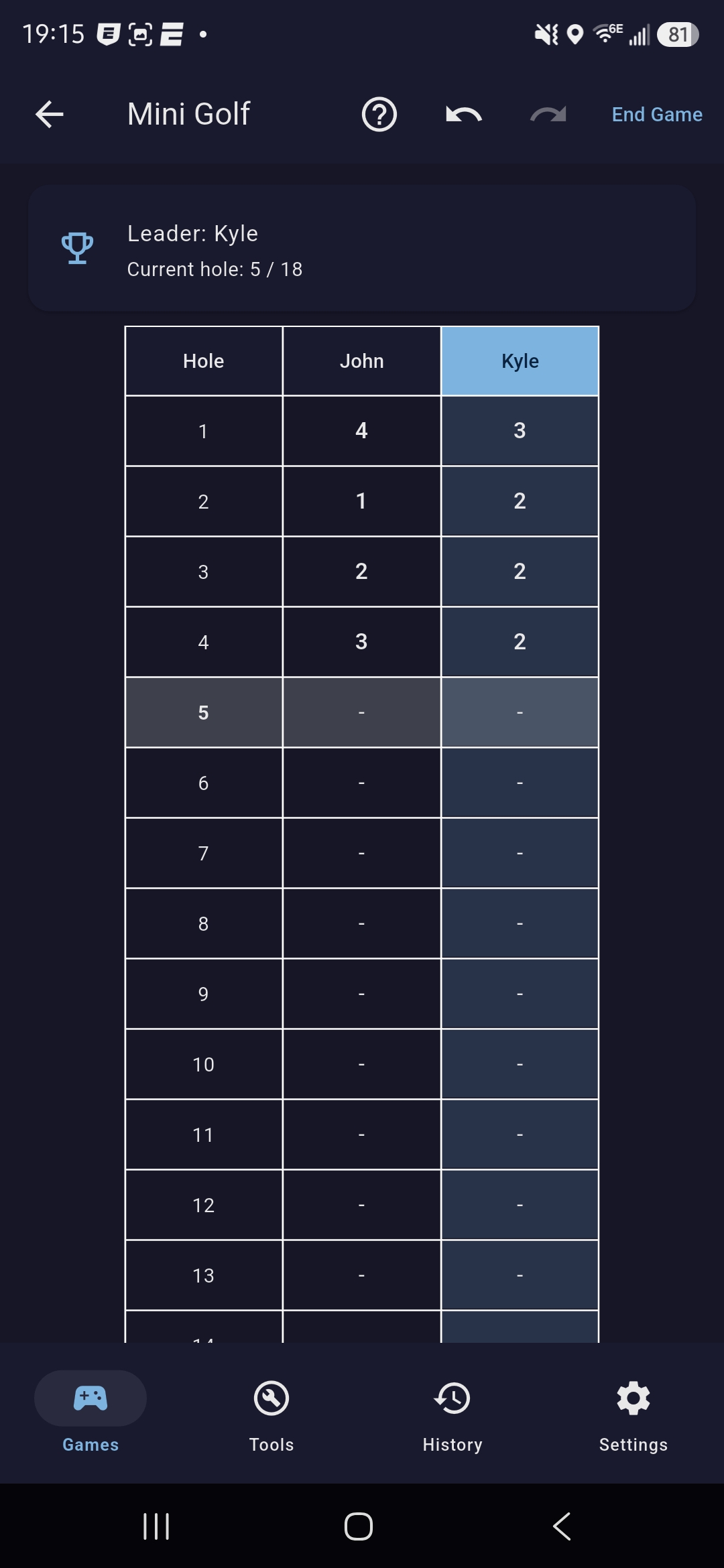
Every swing that moves the ball is one stroke. When the ball drops in the cup, write the number of strokes in that hole's box under your name. After the last hole, add each column. The lowest total wins.
Most courses print a par for each hole on the card, usually 2 or 3. Par gives you something to compare against, but the result is decided on total strokes.
A maximum number of strokes per hole
Nearly every course sets a stroke limit so one bad hole doesn't hold up the players behind. It is printed on the scorecard or on a sign at the first tee.
- Six is the most common limit. If the ball isn't in after five strokes, pick it up and write 6.
- Some courses use 5 or 7 instead, and some let you take a sixth stroke and write 7 if that misses too. Tournament rules from the World Minigolf Sport Federation work this way: six strokes, then a 7.
- If the course doesn't post a limit, agree on one before the first hole.
Out-of-bounds and water
When the ball leaves the playing surface or lands in water, the common options are:
- One-stroke penalty, replace at the edge. Put the ball back where it left the hole or went into the water, add one stroke, and play on. This is the most widely posted rule.
- One-stroke penalty, replay. Add one stroke and hit again from where you just played.
- No penalty. Many family groups just put the ball back where it went out and carry on.
A ball resting against a wall or obstacle is a separate case. Most courses let you move it one putter head's length (about six inches) away from the wall with no penalty, so you have room to swing.
Order of play
Two approaches are common. In the first, each player finishes the hole before the next one tees off, which is quicker and keeps balls from colliding. In the second, everyone tees off and then the player farthest from the cup putts next, as in golf. If a moving ball hits a ball at rest, the usual rule is to put the resting ball back where it was and play the moving ball from where it stops.
Holes-in-one
A hole-in-one is simply a 1 on the card. It has no bonus value in the score. Many courses offer a prize for an ace on the final hole, often a free game, but that is a promotion, not a scoring rule. Groups often circle aces on the card so they can be used to break a tie.
Ties and playoffs
There is no standard tie-breaker, so pick one before you start:
- Share the win. Perfectly reasonable for a casual round.
- Sudden-death playoff. The tied players replay a hole, usually the first or the last. The lowest score on that hole wins, and if they tie again they move to the next hole.
- Count back. The tied player with the most holes-in-one wins, or the one with the lower score on the last hole, then the hole before it, and so on.
A worked scorecard
Three players, nine holes, a six-stroke limit and a one-stroke penalty for water.
| Hole | Par | Ava | Ben | Cy |
|---|---|---|---|---|
| 1 | 2 | 2 | 3 | 2 |
| 2 | 2 | 3 | 2 | 2 |
| 3 | 3 | 3 | 6 | 4 |
| 4 | 2 | 1 | 2 | 2 |
| 5 | 3 | 4 | 3 | 3 |
| 6 | 2 | 2 | 2 | 3 |
| 7 | 2 | 2 | 3 | 1 |
| 8 | 3 | 3 | 4 | 3 |
| 9 | 3 | 2 | 2 | 2 |
| Total | 22 | 22 | 27 | 22 |
- Hole 3, Ben: still not in after five strokes, so he picks up and takes the limit of 6.
- Hole 6, Cy: two strokes plus a one-stroke penalty for a ball in the water makes 3.
- Holes-in-one: Ava on hole 4 and Cy on hole 7. Each is just a 1.
- Result: Ava and Cy tie on 22 and Ben has 27. Counting back by holes-in-one doesn't split them (one each), so they replay hole 1. Ava makes 2 and Cy makes 3, and Ava wins.